
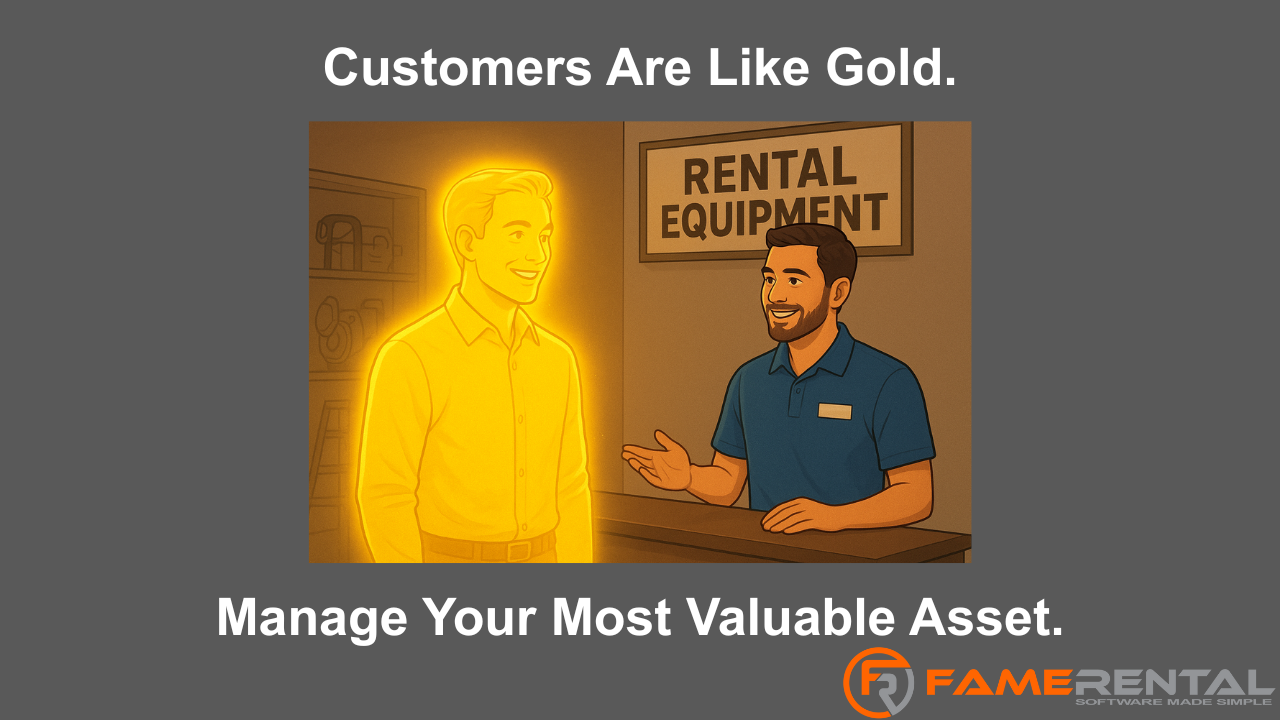
Customers are like gold—rare, costly to acquire, and immensely valuable once you have them. Like your most expensive piece of equipment, it requires the highest level of attention and care over a long period of time. Every asset you care about should be monitored using five essential questions. These same questions apply to your customers—because they, too, are among your most valuable assets. This post shows you how to manage the customer as an asset.
This post is the third part of our “Asset Mindset” series. If you missed the first two, you can read them here:
• How to Manage Your Equipment as Assets
• How to Manage Your Employees as Assets
Most companies organize around this value with sales, marketing, and customer service departments. Titles like Customer Success Manager ~~or Customer Happiness Rep~~ reflect this awareness.
But here’s a challenge:
Find one person in your company who doesn’t touch a customer—directly or indirectly. If such a person exists, ask yourself: Why are they here?
A Harvard study drew a direct correlation between employee satisfaction and customer satisfaction. In other words, if your people are happy, your customers will be too. To truly succeed, you must first connect and empower your own people. Treating customers as assets requires a foundation of connected and caring employees.
To truly treat customers as assets, you must be able to answer five questions—not in the abstract, but for each individual customer: We start with the core five:
- Where are they?
- What are they doing?
- How are they doing?
- What do they need now?
- What are they going to need next?
Treating customers like gold requires a foundational truth: everyone needs access to accurate, complete, and current customer information—anytime, from anywhere. Achieving this requires a connected, single-source-of-truth system that unites CRM, ERP, and operational data.
1. Where Are They?
The answer depends on who’s asking.
- Sales might mean geographically—where they are physically located.
- Marketing might mean strategically—which markets or segments they represent.
- Accounting might mean financially—where they stand with open invoices.
A CRM helps track many of these things, but it becomes far more powerful when fully integrated with your operational systems.
2. What Are They Doing?
Again, the answer depends on perspective.
- Sales wants to know what the customer is working on and how to help.
- Marketing looks for patterns—what they typically do and what messages resonate.
- Service focuses on what projects are active and how the company is supporting them.
The deeper your understanding, the more opportunities you uncover. Often, when you dig deeply enough, you’ll identify unmet needs that open up entirely new lines of business.
3. How Are They Doing?
This question matters to everyone.
- Are they growing quickly and struggling to scale?
- Are they in a downturn and in need of patience and support?
- Are your current projects going well—or just okay?
Knowing how your customers are truly doing allows you to respond with empathy, insight, and relevance.
4. What Do They Need Now?
Once you know what they’re doing and how they’re doing, you can pinpoint how best to help—whether through your existing products and services or by collaborating with other providers to create new value.
The key is to set your company apart through responsiveness, creativity, and genuine care. When you build intimate, informed relationships, you’ll leave competitors behind.
5. What Are They Going to Need?
Don’t stop at today’s needs. Look ahead with them.
Understand their goals, strategies, and long-term challenges—and position your company as a partner in achieving them. To do this well, everyone in your organization should understand your strategy for each customer and know how their own role contributes to it.
The Future of Customer Relationships
You may never fully reach this “customer utopia.” But striving for it will transform your company. When you treat your customers with transparency and fairness—like family—price becomes less relevant. Your employees will feel aligned and motivated. Your customers will go out of their way to do business with you.
And new customers? They’ll find you. Because you’ll already know where they are, what they need, and how to help them succeed.
Joe Lewis
CEO
Fame Rental
Fame Rental improves rental businesses and the lives of their employees and customers. We do this because we care more deeply, listen more intently, and act more methodically than anyone in the rental industry would ever expect from a software company.
Contact us at sales@fameintel.com to schedule a demo.


0 Comments