
Why Rental Companies Should Adopt ROA Over Traditional Metrics
Seeking Your Industry Insights
This blog poses questions more so than making assertions. I welcome your observations, experience, and feedback on this.
Before we dive in, see how this works in the FameAir platform – you’ll see exactly how comprehensive asset performance measurement works, including the scenarios we’ll discuss where traditional metrics can be misleading.
Having spent most of my career in Fixed Assets Management software with companies like Waste Management, Estee Lauder, Yamaha, and Lockheed, I’ve learned numerous disciplines needed to maximize ‘return’ on Fixed Asset investments. This technical DNA makes me a bit of an Asset nerd, and with my Math degree, arguably a double nerd.
The Measurement Framework
William Thompson wrote: “When you can measure what you are talking about, and express it in numbers, you know something about it; but when you cannot measure it, when you cannot express it in numbers, your knowledge is of a meager and unsatisfactory kind.” I would add that if the ‘numbers’ that you do have reflect only partial measures, you can be fooled into thinking you know something when you do not.
Return on Assets Fundamentals
One key measure in business management is Return on Assets (ROA), which measures how efficiently a company uses assets to generate profit. For rental companies specifically, we focus on ROSA (Return On a Specific Asset) – measuring the profitability of individual rental equipment. In its simplest form, ROSA is Net Revenue generated by the Asset divided by the Assets’ Cost. Specifically:
- ‘Net’ Revenue accounts for both all revenues and all related expenses – Rental revenue, maintenance revenue, interest income, depreciation expense, maintenance costs, interest expense, property tax, etc. In essence, its profitability
- ‘Asset Cost’ incorporates original cost, plus improvements, and minus impairments
For non-income-producing assets, determining net revenue is often impractical, making ROA challenging, if not unsuitable for those asset classes. But for Rental companies, measuring ROSA for equipment seems too obvious to ignore.
Traditional Rental Metrics and Their Limitations
When I entered the Rental community, particularly with ARA members, I discovered their ‘standard’ metrics are:
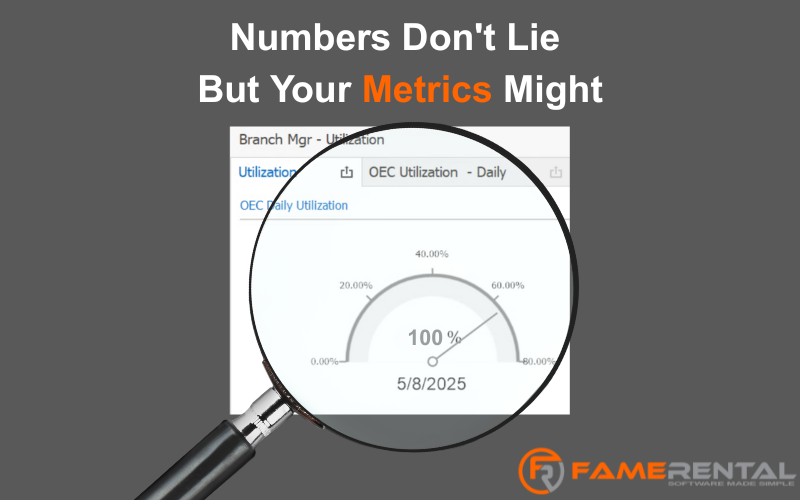
1. Financial Utilization – Rental Revenue divided by Original Equipment Cost (OEC).
2. Time Utilization – Days on Rent divided by Days Available.
These metrics have served the industry for years, but create an incomplete picture—like seeing morning sunshine and assuming “it’s a nice day” despite approaching storms.
Financial Utilization (I would love to create an acronym for this, but it would be FU, which doesn’t quite work):
- Does not take costs into account, and therefore does not provide insight into profitability
- Uses the Original Cost, not the Adjusted Cost Basis
- Does not contain the information building blocks necessary to project forward
- Does not inform you of what needs to be corrected if the asset, cat-class, or category is underperforming
Financial Utilization, coupled with Time Utilization, can indicate if things look acceptable (looks like a sunny day). But are they really okay? And, if not, what actions should you take? There is nothing in the measure to guide you to a better resolution.
Implementation Challenges
If ROSA overcomes Financial Utilization’s limitations, why is that not the standard measure? Why not adopt it? Is it because necessary information is scattered across separate systems—General Accounting, Asset Accounting, Rental Management, Equipment Maintenance, and Financing spreadsheets—making comprehensive cost and revenue tracking nearly impossible? Or, is it something else?
A Cautionary Tale from Coal Mining
Early in my career, I developed cost-per-ton measurements (by mine and section) for a five-generation coal mining operation. Pre-strike, they sold coal at $65/ton with costs between $50-60/ton depending on the section. Post-strike, costs increased by $10/ton without price increases, causing underperforming sections to lose up to $5/ton. For a variety of reasons, they continued mining these sections and went bankrupt within a year.
The moral? Costs matter; profitability matters more. For rental companies, each cat-class at each location represents a mining section. Are you making money? Do you truly know? Will Financial Utilization, coupled with Time Utilization tell you?
Industry Adoption and Your Feedback
I’m told that many large Equipment Rental companies do use ROSA. Are you? Should you? Can you implement it if you wanted to? Would it make a difference in your operations if you did?
Ready to optimize your ROSA?
I welcome your feedback on all of this and promise to respond.


0 Comments